
Mao Zedong's References to Clausewitz
by Yuanlin Zhang
Zhang Yuanlin, "Mao Zedongs Bezugnahme auf Clausewitz," Archiv für Kulturgeschichte Volume 81: Issue 2, pp. 444–471, published online 1 Dec 1999. https://doi.org/10.7788/akg.1999.81.2.443. Read in the original GERMAN. We would like to talk to Dr. Zhang about his work on Mao and Clausewitz. If you have his contact info or know where he is working, please pass it to us.
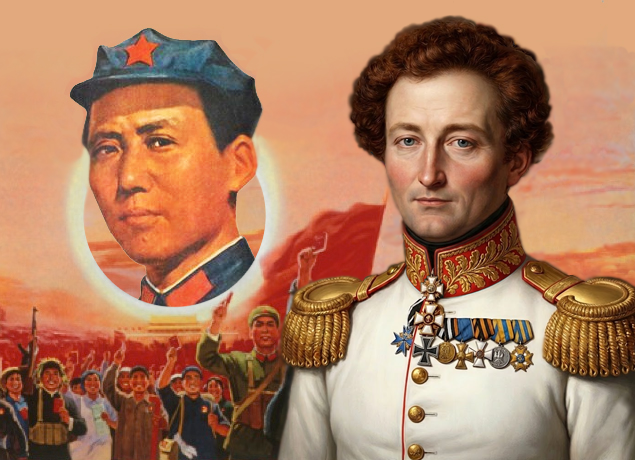
The Prussian Major General Carl von Clausewitz (1780–1831) has been and continues to be regarded in China as the founder and principal exponent of modern European military theory.*1 The translation of his magnum opus, On War, has a long history there.*2 Mao Zedong*3 (1893–1976) is renowned not only as the political leader of the Chinese Revolution, but also as its military strategist and tactician. Clausewitz and Mao lived in different eras and belonged to two widely separated nations. Did an intellectual relationship exist between them? Hitherto, several publications have touched upon this puzzle without resolving it in the least. The purpose of the present essay is to investigate and substantiate Mao Zedong's intellectual engagement with Clausewitz in concrete terms.
I. Previous Research on This Topic
I deem it appropriate first to offer a brief assessment of the existing literature on Mao and Clausewitz before addressing the core objective of the present study.
*1. Cf. Li Yuri, Studies of the Classics of Military Theory in East and West (Guilin, 1943), p. 2; Jing En, "The Progress and Limitations of Clausewitzian Military Theory," in Chinese Military Science, no. 2 (1988) [in Chinese], pp. 68 ff.
*2. Cf. Zhang Yuan-Lin, "Die chinesischen Ausgaben des Werkes Vom Kriege von Carl von Clausewitz," in Österreichische Militärische Zeitschrift, no. 3 (1990), pp. 229 ff.
*3. In the present study, the author has chosen to employ the Chinese Pinyin romanization system, on the grounds that Pinyin has established itself completely not only in the foreign-language publications of the People's Republic of China, but also increasingly within the international scholarly community. Under the rules of Pinyin, one writes, for example, Mao Zedong instead of Mao Tse-tung, Jiang Jieshi instead of Chiang Kai-shek. Within direct quotations, however, original names and terminology are preserved unaltered.
[444]
While it remained unknown until very recent times "whether the strategist of the protracted people's war, Mao Tse-tung, was himself a reader of Clausewitz,"*4 several scholars did touch upon this subject in their Clausewitz studies and noted certain similarities between the views of Clausewitz and Mao. The renowned Clausewitz scholar Werner Hahlweg, who in the 1950s conducted a thorough and systematic investigation into Lenin's relationship to Clausewitz,*5 noted Mao's references to Clausewitz as early as the 1960s and believed that Clausewitz was indeed known to Mao Zedong.*6 Mao, he noted, had quoted and commented upon the maxim defining war as the "continuation of politics by other means."*7 At that time, however, Hahlweg did not yet explain the path through which Mao arrived at Clausewitz's core ideas regarding the relationship between politics and war. Moreover, he admitted: "From these few remarks, however, it cannot be inferred with certainty whether Mao Tse-tung pursued a deeper engagement with Clausewitz or merely quoted him as a slogan."*8 In the 1970s, Hahlweg pursued this topic further. In his view, Mao was among the leading guerrilla strategists and theorists and had utilized the ideas in On War for his own purposes. "Furthermore, Mao Tse-tung invoked Clausewitz in his 1937 pamphlet on the conduct of guerrilla warfare where he sought to comprehend the unique character of wars according to the diversity of peoples and epochs. Clausewitz, he noted, had written in On War that wars possess independent forms and independent conditions; hence every period must possess its own theory of war."*9
-------------------------------------------------
*4. Dietmar Schössler, Carl von Clausewitz mit Selbstzeugnissen und Bilddokumenten (Reinbek bei Hamburg, 1991), p. 128.
*5. Werner Hahlweg, "Lenin und Clausewitz. Ein Beitrag zur politischen Ideengeschichte des 20. Jahrhunderts," in Archiv für Kulturgeschichte 36 (1954), nos. 1, 3.
*6. Carl von Clausewitz, Schriften–Aufsätze–Studien–Briefe. Dokumente aus dem Clausewitz-, Scharnhorst- und Gneisenau-Nachlass sowie aus öffentlichen und privaten Sammlungen, ed. Werner Hahlweg, vol. 1 (Göttingen, 1966), p. 24.
*7. Ibid.
*8. Ibid.
*9. Werner Hahlweg, "Das Clausewitzbild einst und jetzt," in Carl von Clausewitz, Vom Kriege (Bonn, 1991), p. 160.
[445]
Finally, Hahlweg offered his view on how Mao Zedong came into contact with Clausewitz: "Incidentally, Mao Tse-tung most likely arrived at Clausewitz through the mediation of Lenin."*10
In the 1960s, Dirk Blasius wrote a substantial article titled "Carl von Clausewitz und die Hauptdenker des Marxismus" [Carl von Clausewitz and the Principal Thinkers of Marxism], pointing out that one must not overlook Mao when addressing the subject of "Carl von Clausewitz and the Principal Thinkers of Marxism." In his view, Mao's interpretation of the core idea of Clausewitzian philosophy of war—namely the relationship between war and politics—permits the conclusion that he engaged thoroughly with the conceptual world of On War. Moreover, Mao must first have encountered Clausewitz's line of thought through Lenin.*11 However, Blasius was unable to assess the extent to which Mao Zedong conducted independent Clausewitz studies beyond that. Nevertheless, this did not deter him from comparing the military theories of Mao and Clausewitz. To him, Mao appeared to have been influenced by Clausewitz on individual points in his practical doctrine of war, though this could not be definitively verified. In his view, for instance, Mao's concept of defense coincides almost verbatim with that of Clausewitz. Clausewitz's concept of the "act of war" [kriegerische Handlung] was likewise adopted by Mao. Furthermore, Blasius believed that Mao's theory of partisan warfare corresponds to specific manifestations of the people's war [Volkskrieg] described by Clausewitz. But "whether a direct influence of Clausewitz on Mao exists on this point" could not be "decided" from his perspective.*12 Taken as a whole, Blasius's studies demonstrate that he devoted himself intensively to comparing Mao and Clausewitz, thereby making a further contribution to the topic. Yet on the questions of whether or to what extent Mao actually studied Clausewitz, he could offer no clear answer.
For the book Mao Tse-tung, Theorie des Guerillakrieges oder Strategie der Dritten Welt [Mao Tse-tung: Theory of Guerrilla Warfare or Strategy of the Third World], Sebastian Haffner authored an introductory essay titled "Mao und Clausewitz," in which he first interpreted the concepts of war in Mao and Clausewitz and then contrasted the five fundamental principles of European warfare with the principles of Mao Zedong's theory of people's war.*13
-------------------------------------------------
*10. Ibid., p. 347.
*11. Dirk Blasius, "Carl von Clausewitz und die Hauptdenker des Marxismus," in Wehrwissenschaftliche Rundschau 5 (1966), pp. 345–346.
*12. Ibid., p. 347.
*13. Sebastian Haffner, "Mao und Clausewitz. Einleitender Essay," in Mao Tse-tung, Theorie des Guerillakrieges oder Strategie der Dritten Welt (Reinbek, 1966), pp. 14–22; reprinted in Günter Dill, ed., Clausewitz in Perspektive (Ullstein, 1980), pp. 652–663.
[446]
Haffner's studies may, to a certain extent, provide incentives to familiarize oneself with European warfare and Chinese guerrilla tactics, but in truth they offer little aid in understanding the military theories of Clausewitz and Mao, because he himself appeared to truly comprehend neither Clausewitz nor Mao.
Wilhelm von Schramm briefly mentioned Mao Zedong at the end of his book Clausewitz: Leben und Werk [Clausewitz: Life and Work], asserting that Mao, as a Leninist, was "likewise a precise connoisseur of Clausewitz and a friend of military philosophy."*14 Yet he provided not a single piece of evidence for this. His assertion that Mao "repeatedly and explicitly stated that the purpose of this continuation of politics by other means was world domination"*15 is completely new to me. In Mao's writings I have never encountered such a formulation; in all likelihood it does not exist.
The French sociologist and Clausewitz scholar Raymond Aron devoted a specific chapter in his work Clausewitz: Den Krieg denken [Clausewitz: Thinking War] titled "Arming the People," in which he addressed the topic of "Mao Tse-tung and the Defensive-Offensive Dialectic." Right at the beginning of this section, Aron summarized the state of his knowledge based on the available sources: "I do not know whether Mao Tse-tung read or studied Clausewitz. He quotes the formula and refers to Lenin's notebooks from 1915 to 1917 ... He employs a military vocabulary that frequently recalls that of On War. But the concepts employed—defense-attack, time-space, interior and exterior lines, annihilation-attrition—belong to a vocabulary that has since become commonplace."*16 "Must one conclude from this that Mao studied Clausewitz? I am unwilling to affirm that. The mode of thought appears to me to be the same for the simple reason that it conforms to common sense and employs the same concepts."*17 Mao, he argued, adopted Lenin's interpretation, even though he remained alien to Clausewitz as an individual and to his intellectual world.*18 Aron subsequently compares several of Mao's views with those of Clausewitz, repeatedly designating Mao as a Clausewitzian.*19
-------------------------------------------------
*14. Wilhelm von Schramm, Clausewitz. Leben und Werk (Esslingen am Neckar, 1976), p. 571.
*15. Ibid.
*16. Raymond Aron, Clausewitz. Den Krieg denken, trans. from French by Irmala Arnsperger (Frankfurt am Main/Berlin, 1980), p. 424 [cf. Raymond Aron, Clausewitz: Philosopher of War, trans. Christine Booker and Norman Stone (London: Routledge, 1983)].
*17. Ibid., p. 433.
*18. Ibid., p. 424.
*19. Ibid., pp. 432, 434.
[447]
Aron argued: "The military contribution to the theory of war made by Mao's writings strikes me as more original than the political one. The latter, as I have summarized it, draws the logical consequences from the Leninist interpretation of Clausewitz."*20 Ultimately, he delivered his verdict in a single sentence: "The Clausewitzian concept, which entered Marxism through Lenin's transmission, determined the historical-political outlook of Mao Tse-tung, at least until the victory of 1949."*21 It is obvious that Aron did not know whether Mao had studied Clausewitz. By comparing selected views of Mao and Clausewitz, he concluded that Mao was essentially a Clausewitzian. But regarding the path through which Mao encountered Clausewitz's train of thought, Aron pointed exclusively to Lenin's Clausewitz interpretation. His definitive judgment concerning the influence of the Clausewitzian concept on "the historical-political outlook of Mao" appears to me to lack empirical foundation and substantiation.
One could cite additional authors who mentioned Mao's relationship to Clausewitz in their research. In general terms, however, the examples cited above reflect the essential state of European research on Mao and Clausewitz. These examples from prior scholarship demonstrate that the relationship between Mao and Clausewitz has attracted the attention of numerous researchers. Working from the available writings of Mao and Clausewitz as well as other source materials, they sought to determine whether Mao shared an intellectual kinship with Clausewitz, the extent to which Clausewitz influenced Mao, and what commonalities and differences existed between the two. Their studies represented initial exploratory efforts in this field and should be regarded as pioneering contributions or source materials for Mao-Clausewitz scholarship. Because Mao had appended a note stating that he quoted the Clausewitzian formula of war as the "continuation of politics by other means" from Lenin's writings, many scholars concluded that Mao encountered Clausewitz's ideas solely through Lenin. Yet they remained unaware of whether Mao arrived at Clausewitz through other avenues as well. While some scholars compared Mao's concepts of people's war, war and politics, and offense and defense with the corresponding ideas in Clausewitz—highlighting Mao's possible intellectual affinity with him—
-------------------------------------------------
*20. Ibid., p. 429.
*21. Ibid., p. 436.
[448]
they provided no direct evidence that Mao personally studied Clausewitz's work and applied Clausewitzian ideas to the Chinese context. Their assessments rested primarily on conjecture. Dietmar Schössler, a leading Clausewitz scholar in Germany, recently summarized the state of Mao-Clausewitz research with great precision: "Until the late 1980s, it could not be determined whether, for instance, Mao also made excerpts from Clausewitz. Thus, one could merely record that the method of thought and concepts in Clausewitz and Mao bore a striking resemblance; yet the explanation for this could be found only in Lenin's mediating role and in the observation that logically thinking strategists simply proceed in a 'Clausewitzian' manner."*22
II. Mao Zedong's References to Clausewitz
Prior to 1978—that is, before China's Reform and Opening Up—it remained taboo to examine Mao Zedong from a scholarly and realistic perspective. He was deified. Nothing could be said or done that might in the slightest way diminish his renown. Consequently, biographies of Mao during that era were written almost exclusively by foreigners. The relationship between Mao and Clausewitz was, naturally, never mentioned in public discourse. Only since the onset of China's Reform and Opening Up in 1978 has it become possible within the People's Republic of China to examine Mao objectively and to gain access to a broader range of archival materials regarding Mao's thought. This makes the present investigation possible.
II.1. Was Mao Zedong a Reader of Clausewitz?
Having gathered materials from Mao's original writings, personal notes, and the memoirs of his contemporaries, and having conducted an extensive investigation, I can now definitively answer the question of whether Mao read Clausewitz's On War: Mao read it, specifically in the spring of 1938.
-------------------------------------------------
*22. Dietmar Schössler, Carl von Clausewitz (see note 4 above), p. 129.
[449]
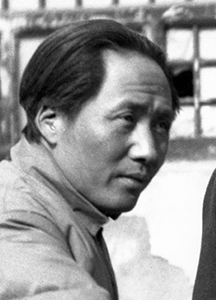
In July 1937, the Japanese army, which had already occupied northeastern China, attacked the city of Beiping—later renamed Beijing (Peking)—with the ultimate intention of subjugating the whole of China. At that moment, the very life and death of the Chinese nation hung in the balance. One of the principal anti-Japanese forces in the country was the "Chinese Workers' and Peasants' Red Army" led by Mao Zedong. Hitherto, it had been relentlessly subjected to encirclement and extermination campaigns by the Guomindang army under the leadership of Jiang Jieshi (Chiang Kai-shek), finally establishing a solid headquarters in Yan'an in October 1935 following the arduous and successful "Long March."*23 Soon, however, it found itself confronted by a war of an entirely new character and quality: the national War of Resistance Against Japanese Aggression. In order to synthesize the lessons of the preceding civil war and formulate the correct policy and strategy for the impending struggle under altered circumstances, Mao read extensively in philosophy, politics, and military theory during this period. According to available records, Mao read, among others, the following works while in Yan'an: Engels's Anti-Dühring, Lenin's On the Question of Dialectics, Plekhanov's The Development of the Monist View of History, and Ai Siqi's On the Method of Thinking and Popular Philosophy, alongside works by Kant, Hegel, and Feuerbach.*24 In addition, Mao intensively studied several Chinese and foreign treatises on military theory and military history, foremost among them Sunzi: The Art of War and Clausewitz's On War.
Gao Lu, one of the contributors to the anthology Mao Zedong beim Lesen [Mao Zedong as a Reader], provided an important clue regarding Mao's study of On War during that period. In his chapter "Mao Zedong and Logic," Gao Lu described how Mao studied logic throughout his lifetime and took an active interest in scholarly debates on the subject. In passing, he noted the following: "In the spring of 1938, Mao Zedong had just finished reading Li Da's Outline of Sociology and was reading Clausewitz's On War.
-------------------------------------------------
*23. Much has already been written on this "25,000-Li March," as the Chinese call it; see, for example: 1) Chen Changfeng, With Chairman Mao on the Long March, 2nd ed. (Beijing, 1972); 2) Edgar Snow, Red Star Over China (Frankfurt am Main, 1974 [New York, 1938]); 3) Harrison E. Salisbury, The Long March: The Untold Story, trans. Guo Jiading, Chen Zhenjiu, and Zhang Yuanyuan (Beijing, 1985); 4) Han Suyin, The Morning Deluge (Zürich, 1972); 5) Mao Zedong's own accounts in his Selected Works, vol. 1 (Beijing, 1968 [English: Beijing, 1965]), pp. 181–187.
*24. Gong Yuzhi, Feng Xianzhi, and Shi Zhongquan, Mao Zedong beim Lesen [Mao Zedong as a Reader] (Sanlian Shudian, Beijing, 1986) [in Chinese], pp. 69–70.
[450]
By March 24, he had read up to page 111 of On War."*25 In his endnote, Gao Lu further quoted Mao's reading diary for March 28, 1938: "On War, read pp. 112–122."*26 To the best of my knowledge, this was the first public disclosure in print establishing exactly when Mao personally read On War. Gao Lu's testimony is trustworthy, as he served for many years as Mao's academic secretary and possessed intimate knowledge regarding the contents of Mao's reading materials and unpublished manuscripts. The volume Mao Zedong as a Reader carries a quasi-official status, even though individual contributors wrote under their own names. Notably, the prominent Chinese leader Deng Xiaoping took a personal interest in the publication of this volume and inscribed the book's title calligraphy for the cover with his own brush.
While Gao Lu's passing mention might have served merely as an indirect clue, we now possess direct and official documentary proof of Mao's study of the work, following the 1988 publication of an anthology titled Mao Zedong's Marginal Glosses on Philosophical Works (compiled and edited by the Department for Document Research of the Central Committee of the Communist Party of China). This anthology brings together Mao's marginal annotations across ten philosophical works. Included within it is Mao's personal reading diary covering the period from February 1 to April 1, 1938.
Here I shall examine this reading diary in detail. As a consequence of the protracted, tense, and dangerous situation in China at the time, Mao was unable to keep a continuous diary, a fact he noted at its very opening: "February 1, 1938. For twenty years I have not kept a diary. Today I shall begin anew, in order to pursue my studies..."*27 Subsequently, in the entries running from February 1 to March 16, 1938, Mao recorded his progress through Li Da's Outline of Sociology. On March 18, 1938, he began reading Clausewitz's On War. In his reading diary he noted:
-------------------------------------------------
*25. Gao Lu, "Mao Zedong und Logik," in Mao Zedong beim Lesen (see note 24 above), p. 122.
*26. Ibid.
*27. Mao Zedongs Randglossen für die philosophischen Schriften [Mao Zedong's Marginal Glosses on Philosophical Writings], ed. Department for Document Research of the Central Committee of the Communist Party of China, 1st ed. (Beijing, 1988) [in Chinese], p. 279.
[451]
The 18th. Began reading Clausewitz's On War. Preface and table of contents, pages 1–19. Book One: On the Nature of War, from page 24. Today finished Chapter 1, up to page 55.
The 19th. Read nothing.
The 20th. Pages 57–91.
The 21st. Pages 92–102.
The 22nd. Read nothing.
The 23rd. Pages 103–111.
The 24th. Read nothing.*28
During the following three days—March 25, 26, and 27, 1938—Mao laid Clausewitz's On War aside to read Pan Zinian's book Logic and Logic Theory (published in October 1937), which had just come to his attention. In the days that followed, Mao resumed reading On War:
The 28th. On War, pp. 112–122.
The 29th. Read nothing.
The 30th. Read nothing.
The 31st. Pages 123–167.
April 1st. Page 168–.*29
The final entry in this reading diary is dated April 1, 1938. On that day, Mao began reading On War from page 168 onward. The diary does not record how many pages he completed on that date. Nor is there documentary evidence establishing whether he subsequently read Clausewitz's principal work through to the very end.
This reading diary was published in facsimile from Mao's own handwriting. The original was kept in a lined notebook comprising seven pages and is preserved in the Central Archives of China. The question of whether Mao ceased keeping a reading diary after April 1, 1938, or whether the remainder of the diary was lost, remains an open one.
Mao's reading diary makes clear that he devoted more time to reading Clausewitz's On War than he typically expended on his other reading materials.
-------------------------------------------------
*28. Ibid., p. 282.
*29. Ibid., p. 283.
[452]
With the exception of the first day (March 18, 1938), on which he read 55 pages, he read fewer than 45 pages each day. Yet when reading Pan Zinian's Logic and Logic Theory, he covered 240 pages in only three days—an average of 80 pages per day. That is to say, he read Logic and Logic Theory much faster than On War. In my view, the reasons for this are twofold:
a) On War is a work written by a foreigner whose mode of expression differs fundamentally from Chinese modes of thought and expression. Such stylistic and conceptual divergences cannot, in principle, be eliminated through translation alone. To this must be added the poor quality of the Chinese translations available at the time. In order to read and comprehend it, Mao necessarily required more time.
b) Mao Zedong paid close attention to this world-renowned classic, unwilling to treat it superficially; he sought to study it thoroughly and truly understand it. It is probably also to this intent that we should trace Mao's personal organization of a "Seminar on Clausewitz's On War" during this period, a subject I shall examine in greater detail below.
With the publication of Mao Zedong's reading diary, the question of whether he read Clausewitz's On War has been definitively resolved.
II.2. Which Chinese Translation of On War Did Mao Zedong Read and Possess?
To gain clarity regarding Mao's Clausewitz studies, it is necessary to investigate further which Chinese translation or translations of Clausewitz's On War Mao read and possessed.
Mao never studied abroad. Although he had once been an organizer of overseas study programs, he intended first to familiarize himself thoroughly with conditions in China before going abroad. Later, developments in the Chinese political situation caused him to abandon this intention altogether. He had virtually no command of foreign languages. Although he had studied a small amount of English, his proficiency was insufficient to read the English edition of On War. Thus, he could read the work only in Chinese translation, not in the original German or any other foreign language. Which Chinese edition did Mao own and read? He left no direct statement on this point. To resolve this question, we must verify the available documents and historical records.
[453]
According to my research, there existed in China four published Chinese editions and one unpublished translation of On War at the time Mao read it in 1938. In order to answer the question posed above and facilitate the subsequent analysis, let us first provide an overview of these editions.
According to historical records, Clausewitz's On War was first introduced into China via Japan in 1910 at the Beiyang Military Academy.*30 The first Chinese edition was published in ten volumes in 1911 by the Society for Military Training Studies [Junxun Yanjiuhui]. In the following year (1912), members of the Association for Military Studies in Guangdong raised funds voluntarily to revise and reprint this edition.*31
Three years later (1915), the second edition appeared, translated by Lieutenant Colonel Qu Shoutie, an instructor at the Baoding Military Academy. Li Yuanhong,*32 then provisional Vice President of the Republic of China, and Jiang Zuobin,*33 Vice Minister of War, contributed forewords to this edition.*34
Even prior to Qu Shoutie's edition, the Baoding Military Academy had organized a translation of On War and used the translated text as instructional material. The third edition, in two volumes, followed in Shanghai in 1934. The translator, Liu Ruoshui, whose primary interest lay in philosophy, likewise translated the work from the Japanese. Liu was full of admiration for Clausewitz's scientific rigor and methodological approach to the study of war.*35
-------------------------------------------------
*30. Cf. Introductory Note by the Association for Military Studies in Guangdong, in Carl von Clausewitz, Vom Kriege, ed. Association for Military Studies in Guangdong (Guangdong, 1912) [in Chinese], p. 1.
*31. Ibid.
*32. Li Yuanhong (1864–1928) was elected Vice President of China upon the founding of the Provisional Government in Nanjing on January 1, 1912. He became President of the Republic following the death of Yuan Shikai on June 6, 1916. Shortly thereafter, he was overthrown by Zhang Xun.
*33. Jiang Zuobin (1884–1942) served as Vice Minister of War from the founding of the Nanjing Provisional Government on January 1, 1912. In 1916, following the death of Yuan Shikai, he became Vice Chief of the General Staff.
*34. Forewords by Li Yuanhong and Jiang Zuobin, in Carl von Clausewitz, Vom Kriege, trans. from Japanese by Lt. Col. Qu Shoutie (Zhonghua Shuju, Shanghai, 1915) [in Chinese], pp. 6–8.
*35. Translator's Preface, in Carl von Clausewitz, Vom Kriege, trans. from Japanese by Liu Ruoshui (Xinken Shudian, Shanghai, 1934) [in Chinese], p. 3.
[454]
During the War of Resistance Against Japan (1937–1945), several Chinese translations of On War appeared in rapid succession. Many argued that the Chinese people needed to understand and master the ancient wisdom of Sunzi alongside Clausewitz's theory of war in order to defeat the technologically superior Japanese aggressors. For most readers, however, On War remained a book with seven seals; contemporary readers were thoroughly dissatisfied with the existing translations.
In 1937, the Military Book Publishing House issued a new translation (the fourth edition). In addition to a preface contributed by Yang Yanchang, the translators included the well-known introduction by Chief of the German General Staff Count Alfred von Schlieffen written for the fifth German edition, as well as the preface by retired Lieutenant Colonel Paul Creuzinger for the eleventh German edition.*36
Among the five versions outlined above, the mimeographed translation used as teaching material at the Beiyang Military Academy was virtually inaccessible to Mao.*37 We may therefore exclude it from our consideration.
Among the remaining four published versions, my research demonstrates that Mao Zedong must have read at least the 1934 Shanghai edition translated into Chinese by Liu Ruoshui. The evidence supporting this conclusion is as follows:
1) The page numbers recorded in Mao's reading diary for the preface and table of contents of On War correspond exactly to the pagination of the preface and table of contents in Liu Ruoshui's edition.*38
2) The opening and closing page numbers for Chapter 1 recorded in Mao's reading diary match almost perfectly with Chapter 1 of that edition. In his diary, Mao wrote: "Book One: On the Nature of War, from page 24. Today finished Chapter 1, up to page 55."*39 In Liu's edition, Chapter 1 runs precisely from page 23 to page 55.*40
-------------------------------------------------
*36. Cf. Carl von Clausewitz, Vom Kriege, trans. from Japanese by the Military Translation Bureau of the Guomindang Army (Military Book Publishing House, Nanjing, 1937) [in Chinese].
*37. Cf. Qu Shoutie, Preface and Explanatory Notes, in Carl von Clausewitz, Vom Kriege (see note 34 above), pp. 9, 13.
*38. Cf. Mao Zedongs Randglossen (see note 27 above), pp. 1–19.
*39. Ibid., p. 282.
*40. Carl von Clausewitz, Vom Kriege (see note 35 above), pp. 23–55.
[455]
Here, page 24 in Mao's reading diary was evidently a clerical error in note-taking.
3) Certain Chinese expressions and technical terminology that Mao employed in his reading diary or in his treatise "On Protracted War"*41 are completely identical with those found in Liu's edition.*42 We shall return to this point in a different context below.
4) Finally, Liu specifically mentioned in his preface Lenin's notebook excerpts from On War as well as Friedrich Engels's remarks on Clausewitz's treatise.*43 This could likewise have provided an incentive for Mao to select and read Liu's edition.
Several documents also provide indications that Mao may have possessed other editions of On War in addition to Liu's. For example, the edition printed by the Military Academy of the Guomindang Army was used as teaching material in the "Seminar on Clausewitz's On War," which I shall discuss in greater detail below.*44 Because that edition was rendered in classical Chinese and was poorly translated, Professor He Sijing, who had studied in Germany, was asked to translate portions of On War directly from the German original into modern Chinese and to make the translated manuscript available to the seminar. This was indeed done.*45 This provides near-conclusive proof that during his study of On War in 1938, Mao utilized and possessed not only Liu's edition, but also that of the Guomindang Army Military Academy and Professor He's translated manuscript. Between 1938 and 1976, six further Chinese editions of Clausewitz's On War appeared in China (including Taiwan), namely:
-------------------------------------------------
*41. Cf. Mao Zedongs Randglossen (see note 27 above), p. 282; Mao Zedong, Ausgewählte Werke, vol. 2, ed. Committee of the Central Committee of the Communist Party of China for the Publication of the Selected Works of Mao Zedong (Foreign Languages Press, Beijing, 1968), pp. 181, 192 [cf. Mao Zedong, "On Protracted War," in Selected Works of Mao Tse-tung, vol. 2 (Beijing: Foreign Languages Press, 1965), pp. 111–194].
*42. Carl von Clausewitz, Vom Kriege (see note 35 above), pp. 28, 35.
*43. Translator's Preface, in Carl von Clausewitz, Vom Kriege (see note 35 above), pp. 4–5.
*44. This is based on General Mo Wenhua's letter of May 25, 1987, which has not yet been officially published.
*45. Ibid.
[456]
1) The edition translated by Fu Daqing, published in 1940;
2) The edition published in 1941 by the National Defense Publishing House in Guilin;
3) The edition translated from Japanese by Li Yuri, published in 1943;*46
4) The edition translated by Huang Huanwen, published in 1947;
5) The edition translated from English by Zhang Baiting and Niu Xianzhong, published in Taiwan in 1956;
6) The edition translated directly from German by the Academy of Military Sciences of the Chinese People's Liberation Army, published in 1964.*47
Among these six editions, I estimate that Mao possessed at least two. Indirect evidence supports this. According to an article titled "A Little-Known Figure of China—Fu Daqing" published in the weekly Wenzhai Bao [Newspaper and Journal Digest] on February 7, 1989, Zhou Enlai (Chou En-lai)*48 telegraphed Fu Daqing at the onset of the War of Resistance Against Japan (1937) to summon him to Chongqing to serve as an interpreter for the group of Soviet military advisers. When Fu learned there that Mao was studying Clausewitz's On War in Yan'an and was suffering from the lack of a competent translation, he offered to translate the work from Russian into Chinese and make it available to Mao and other leaders of the Communist Party and the Eighth Route Army. When Fu's translation appeared in 1940, it was hailed by Mao's closest comrades-in-arms—Commander-in-Chief Zhu De (Chu Teh),*49 who had studied in Germany, and Chief of Staff Ye Jianying—as "the finest translated text in China."*50
-------------------------------------------------
*46. Cf. Translator's Preface, in Carl von Clausewitz, Vom Kriege (see note 35 above), p. 5; cf. review by Cheng Suichu, in Carl von Clausewitz, Vom Kriege, abridged and trans. Huang Huanwen (Shangwu Yinshuguan, Shanghai, 1946) [in Chinese], p. 11.
*47. Cf. Zhang Yuan-Lin, "Die chinesischen Ausgaben des Werkes Vom Kriege" (see note 2 above), p. 229.
*48. Zhou Enlai (1898–1976), the longtime Premier of the People's Republic of China. During the 1920s, he studied in Paris, Göttingen, and Berlin.
*49. Zhu De (1886–1976), one of the co-founders and senior military commanders of the People's Liberation Army and the People's Republic of China. Regarding his studies in Germany, he spent two semesters studying sociology in Göttingen between 1922 and 1925, followed by two years attending lectures in sociology and military science in Berlin.
*50. Cf. the article "A Little-Known Figure—Fu Daqing," in Wenzhai Bao, February 7, 1989 [in Chinese], p. 2.
[457]
It stands to reason that Fu Daqing's version was likewise made available to Mao.
In addition, Mao almost certainly possessed the translation prepared by the Academy of Military Sciences of the Chinese People's Liberation Army, the first edition of which appeared in 1964. This edition very likely remains preserved in Mao's private library today, although I am currently unable to confirm this definitively.
II.3. Did Mao Zedong Organize a "Seminar on Clausewitz's On War"?
If scholars might already find it astonishing that Mao was a reader of Clausewitz, it will perhaps surprise them even more to learn that in the spring of 1938, Mao personally organized and conducted a seminar on Clausewitz's On War.
The situation was undergoing rapid change. In order to meet these new challenges, Mao sought to elevate his theoretical understanding to match the emerging tasks. Concurrently, he aimed to foster study and training across his party and army in the fields of philosophy, politics, military theory, and military history in Yan'an. Following the outbreak of the War of Resistance Against Japan, numerous lectures, symposia, and study groups were established in Yan'an. The "Research Society for the War of Resistance Against Japanese Aggression" was founded. In 1938, Mao personally conducted at least two seminars: the "Seminar on Clausewitz's On War" and the "Seminar on Philosophical Questions." Many of Mao's subsequent writings originated directly from the lectures he delivered during this period.
General Mo Wenhua, a participant in both seminars organized by Mao, recalled the "Seminar on Clausewitz's On War" in a letter dated May 25, 1987:
[458]
It was early 1938 in Yan'an. The seminar convened in Chairman Mao Zedong's living quarters on Fenghuang Mountain in Yan'an. In addition to Chairman Mao, the participants included Xiao Jinguang, Luo Ruiqing, Teng Daiyuan, Mo Wenhua, and Ye Zilong,*51 among others. Copies of the edition published by the Guomindang Military Academy and the manuscript translated directly from the original German by Professor He Sijing were utilized as instructional material. The seminar met once a week, and sessions typically lasted from approximately 7:00 PM to past 11:00 PM. Each time, Professor He would first distribute the instructional material and explicate it section by section. Following the explanation of the text, an assigned participant would deliver a presentation, after which the group discussed specific questions and problems. At the conclusion of the session, Chairman Mao would summarize the proceedings and offer his own views, whereupon the meeting adjourned. The seminar covered only the first part of On War. On these occasions, Chairman Mao spoke primarily on the concentration of forces and the strategic stages of the war, among other topics.*52
Mao's Clausewitz studies stimulated further research on Clausewitz and the translation of Clausewitz's writings within academic circles in Yan'an. For example, in July 1939, in issue no. 7 of the Journal of Military and Politics [Junzheng Zazhi], the Military and Political Publishing House of the Eighth Route Army published Jiao Minzhi's translation of the "Introduction to the Russian Edition of Clausewitz's On War." In issue no. 12 of 1939 and issue nos. 1 and 2 of 1940 of the same journal, Professor He Sijing's multi-part article "Lenin and Clausewitz" appeared in serialization. Furthermore, in October 1939, the publisher issued the pamphlet translated into Chinese by Yang Zuocai titled Lenin and Clausewitz's "On War": Excerpts and Marginal Glosses, followed in November 1940 by the pamphlet translated by Xiao Guangwei, Appendix to Clausewitz's "On War".*53 These latter two pamphlets formed part of the "War of Resistance Against Japan Series." In August 1941, the same publishing house reprinted Qu Shoutie's translation of On War.
-------------------------------------------------
*51. For biographical profiles of these participants, see Wu Lusong, ed., Biographical Dictionary of Chinese Military Figures (Xinhua Shuju, Shanghai, 1989) [in Chinese].
*52. See note 44 above.
*53. This pamphlet contained the following shorter writings by Clausewitz: 1. "The Most Important Principles for the Conduct of War, to Supplement My Instructions to His Royal Highness the Crown Prince" [Die wichtigsten Grundsätze des Kriegführens...]; 2. "On the Organic Division of Armed Forces" [Über die organische Einteilung der Streitkräfte]; 3. "Outline of a Plan for Tactics or the Theory of Combat" [Skizze eines Planes zur Taktik oder Gefechtslehre]; 4. "Guide to the Elaboration of Tactics or the Theory of Combat" [Leitfaden zur Bearbeitung der Taktik oder der Gefechtslehre].
[459]
During this period, several excerpts from On War translated by Fu Daqing—including "On the Culminating Point of Victory," "War Is an Instrument of Policy," and "The Most Important Principles for the Conduct of War"—were published serially in the weekly journal Masses [Qunzhong]*54 in vol. 3, no. 22, and vol. 4, nos. 9 and 15. The "Kang-Da" (the Chinese People's Anti-Japanese Military and Political University in Yan'an) compiled several articles into a booklet titled Studies of Clausewitz's "On War" and distributed it as assigned reading.
Mao was no mere soldier. He studied military theoretical treatises during this period, including On War, not simply to acquire professional technical knowledge; rather, his objective was to conduct the War of Resistance with the aid of military-philosophical insights so that the militarily superior occupying power could be expelled. More concretely: Mao sought to extract practical utility from the essence of historical military experience and military philosophy in order to refute the erroneous doctrines then prevailing in China concerning either "the inevitable subjugation of China" or a "quick victory over Japan," and to establish a political-military and strategic doctrine tailored to China's realities. A fruit of these studies was Mao's subsequent formulation of the comprehensive strategy against the Japanese occupation. This strategy is embodied primarily in his treatise "On Protracted War," which addressed three central questions: Why must the War of Resistance Against Japan be a protracted war? Why could China ultimately achieve victory? How should this protracted war be conducted to reach final victory? This work was the product of his multifaceted, purpose-driven studies and his systematic investigation of concrete Chinese practice; Mao's Clausewitz studies made a distinct contribution toward this end.
II.4. Other Channels That May Have Led to Mao's Encounter with Clausewitz's Thought
First, it can be established that Mao encountered Clausewitz's ideas when reading the works of Lenin and other Marxist authors, as several Clausewitz scholars such as Werner Hahlweg and Raymond Aron have already noted.
-------------------------------------------------
*54. Qunzhong [The Masses], the official political weekly of the Communist Party of China published during the War of Resistance Against Japan (1937–1945).
[460]
Furthermore, Mao could have encountered the ideas of Clausewitz by reading the military textbooks, doctrine manuals, and doctrinal articles of the Guomindang army. My investigation reveals that the Guomindang leadership and its senior generals appreciated and studied Clausewitz's military theory no less than Mao and his followers.
Jiang Jieshi (Chiang Kai-shek) was an assiduous reader of Clausewitz. By his own account, Jiang had read Clausewitz's On War several times prior to 1919, highlighting numerous passages with circles and dotted lines.*55 Later he reread it repeatedly, adding thirteen distinct sets of marginal commentaries (one commentary on Book I of On War; two on Book II; three on Book III; three on Book VI; one on Book VII; three on Book VIII).*56
Jiang Jieshi even authored an essay titled "My Impressions upon Reading Clausewitz's Work." In it he wrote, among other things:
"Clausewitz's theory of war, imbued with a thoroughly philosophical spirit, is a genuine philosophy of war; it is applicable not only to the conduct of war, but equally to political, diplomatic, and economic pursuits, as well as diverse social activities. If one can dedicate oneself intensively to its study and understand his work from the ground up, it will provide an inexhaustible and ingenious source of aid for our revolutionary cause and for all stratagems. For this reason, soldiers as well as party members, administrative officials, and all revolutionary cadres fighting on the frontline against the enemy must thoroughly study Clausewitz's theory of war. Regarding my own military thought, I was influenced most by two books: the first is Balck's Tactics,*57 which was written by a simple civilian, not a famous military figure, but was highly regarded by ordinary German soldiers and valued as an indispensable work ... The second is Clausewitz's On War."*58
-------------------------------------------------
*55. Luo Yun, The Essence of Clausewitz's "On War" (Xiangyun Chubanshe, Taipei, 1965) [in Chinese], pp. 114 ff.
*56. Niu Xianzhong, Introduction, in Carl von Clausewitz, Vom Kriege, trans. Niu Xianzhong (Taipei, 1980) [in Chinese], pp. 1177 ff.; cf. Luo Yun, The Essence of Clausewitz's "On War" (see note 55 above), pp. 18, 26–29, 32, 36, 37–38, 41–42, 60–62, 72–73, 79–81, 93, 99, 102–103, 110–111, and 114–118.
*57. [Translator's note: Zhang remarks here: "I have not yet been able to locate this book. During my investigation I could only trace a Lieutenant William Balck from Germany who published a short treatise titled Kleiner Krieg in 1923..." In fact, "Balck's Tactics" refers to the famous two-volume classic Taktik (1896–1903) by Prussian Lieutenant General William Balck (1858–1924), which was translated into English by Walter Krueger in 1911–1914 and widely translated and studied in Japanese and Chinese military academies. Chiang Kai-shek's assertion that Balck was an "ordinary civilian" was simply mistaken.]
*58. Luo Yun, The Essence of Clausewitz's "On War" (see note 55 above), p. 115.
[461]
In addition to Jiang Jieshi, several other Chinese military theorists during the Republican era (1912–1949) took an active interest in Clausewitzian theory. For instance, Jiang Baili (1882–1938), who in 1938 served as acting commandant of the Guomindang Army Military Academy, incorporated Clausewitz's ideas so extensively into his books On National Defense [Guofang Lun] and A New Interpretation of Sunzi's Military Theory*59 that commentators observed: "Jiang Baili's conception of war is similar to that of Clausewitz. One can say that it is Clausewitz's view expressed in Jiang Baili's words."*60 Numerous Guomindang generals had studied abroad. Jiang Jieshi himself had studied at a military academy in Japan.
German military advisers also operated in China under the leadership of Lieutenant Colonel Max Bauer, Lieutenant Colonel Hermann Kriebel (1929–1930), Lieutenant General Georg Wetzell (1930–1934), Colonel General Hans von Seeckt (1934–1935), and General Alexander von Falkenhausen (1935–1938).*61 Among them, Hans von Seeckt at the very least can be regarded as a keen student of Clausewitz.*62
Guomindang military doctrine manuals drew heavily upon foreign military theories, leading Mao, upon reading them, to conclude that "the military manuals issued by the reactionary Chinese government and the reactionary Chinese military academies" merely "expound the general laws of war and, moreover, are entirely copied from foreign sources."*63 These regulations undoubtedly drew upon Clausewitzian sources. Through his critical engagement with Guomindang military manuals and regulations, Mao could thus also have encountered Clausewitz's lines of thought.
-------------------------------------------------
*59. Jiang Baili attended a military academy in Japan from 1901 to 1906. Subsequently, he pursued advanced studies in Germany and completed an internship as a company commander in the German Army. In 1910 he returned to China. In 1912 he became commandant of the Baoding Military Academy. In 1938 he was appointed acting commandant of the Guomindang Army Military Academy. In November of the same year he succumbed to illness. He was an influential Chinese patriotic military theorist.
*60. Lu Huchun, Studies of Bourgeois Military Thought (National Defense University Press, Beijing, 1987) [in Chinese], p. 82.
*61. Cf. Wolfgang Franke and Brunhild Staiger, eds., China Handbuch, German Association for East Asian Studies (Bertelsmann Universitätsverlag, Düsseldorf, 1974), p. 876.
*62. Cf. Hans von Seeckt, "Clausewitz, zum 150. Geburtstag," in Gedanken eines Soldaten, exp. ed. (Leipzig, 1935), pp. 23 ff.
*63. Mao Zedong, Ausgewählte Werke, vol. 1 (Beijing, 1968), p. 211 [cf. "Problems of Strategy in China's Revolutionary War," in Selected Works of Mao Tse-tung, vol. 1 (Beijing: Foreign Languages Press, 1965), p. 181].
[462]
Among Mao's close comrades, a significant number had likewise studied abroad, particularly in Germany, France, and Russia: for example, Zhu De (former Commander-in-Chief of the Red Army, the Eighth Route Army, and later the People's Liberation Army) in Germany; Zhou Enlai (the former Premier) in France and Germany; Marshal Liu Bocheng in the Soviet Union... Many intellectuals, such as the aforementioned Professor He Sijing, also returned to China from abroad following the outbreak of the War of Resistance Against Japan.
It is noteworthy that a former German officer named Otto Braun (originating from Ismaning near Munich), who assumed the Chinese name "Li De," served as a military adviser to the Central Committee of the Communist Party of China from 1932 to 1939. He had reportedly been dispatched to China by the Communist International (Comintern). Braun was the only foreigner to participate in the Long March. He exercised substantial influence over the party and military leadership when the Moscow-trained dogmatists held sway at the head of the CPC. However, when Mao Zedong assumed leadership of the party and the army in 1935, "Li De" was simultaneously removed from the center of power. Later in Yan'an, he served as an instructor at the Military and Political University.*64 It was said that he possessed a fluent tongue and frequently cited great historical figures such as Caesar, Napoleon, Frederick the Great, Clausewitz, and Moltke in conversation.*65 Later, Otto Braun also demonstrated his enduring interest in Lenin's Clausewitz studies by publishing an edited volume of Lenin's Clausewitz notebooks in Berlin in 1957.*66 I would not rule out the possibility that Otto Braun likewise contributed to Mao's engagement with On War.
-------------------------------------------------
*64. Cf. Lexikon der modernen Geschichte Chinas [Dictionary of Modern Chinese History] (Beijing, 1987) [in Chinese], p. 460.
*65. Harrison E. Salisbury, The Long March: The Untold Story (see note 23 above), p. 44.
*66. Cf. V. I. Lenin, Clausewitz' Werk "Vom Kriege": Auszüge und Randglossen, with preface and notes by Otto Braun (Verlag des Ministeriums für Nationale Verteidigung, Berlin, 1957).
[463]
Finally, Mao was an omnivorous reader. Among the extensive range of books, newspapers, and journals he devoured during wartime, he could readily encounter writings by and about Clausewitz from time to time.*67 Through these diverse channels, Mao was repeatedly brought into contact, directly or indirectly, with Clausewitz's thought.
II.5. To What Extent, in What Manner, and Under What Circumstances Did Mao Zedong Incorporate Clausewitz's Views into His Military Theory?
Mao Zedong's study of On War left unmistakable imprints upon his treatise "On Protracted War."
Shortly after his intensive reading of On War—namely in May 1938—Mao authored the seminal military treatise "On Protracted War," in which he cited Clausewitz both directly and indirectly.
When analyzing the relationship between war and politics in the section titled "War and Politics," Mao wrote: "'War is the continuation of politics.' In this sense war is politics and war itself is a political action;... But war has its own particular characteristics and in this sense it cannot be equated with politics in general. 'War is merely the continuation of policy by other means.'"*68 The sentence enclosed in quotation marks in this passage is precisely the famous Clausewitzian formula. The question arises, however, whether Clausewitz was quoted here directly or indirectly. The sentence "War is merely the continuation of policy by other means" in this passage was accompanied by the following footnote: "Cf. V. I. Lenin, Socialism and War, Chapter 1, and The Collapse of the Second International, Section 3."*69 This demonstrates that Mao quoted Clausewitz here indirectly via Lenin. Nevertheless, it is entirely possible that Mao had also familiarized himself with this famous maxim through his own direct reading of On War. This dictum, which appears in Chapter 1 of Book I—a chapter Mao had read thoroughly—undoubtedly left a deep impression on him, one that remained fresh in his mind while drafting "On Protracted War."
-------------------------------------------------
*67. Cf. Chen Changfeng, Mit dem Vorsitzenden Mao auf dem Langen Marsch, 6th ed. (Beijing, 1960) [in Chinese], pp. 9 ff. According to the recollections of Mao's bodyguard, whenever the Red Army halted in a town during the Long March, Mao either went in person to the post office (which then also functioned as a bookstore) or sent staff to purchase newspapers, periodicals, and books. Other sources indicate that in Yan'an, Mao frequently asked friends in major cities to purchase books and ship them to him.
*68. Mao Zedong, Ausgewählte Werke (see note 63 above), pp. 177–178 [cf. "On Protracted War," in Selected Works, vol. 2, pp. 152–153].
*69. Ibid., p. 227 [note 20 in the English edition].
[464]
In the same chapter, Mao asserted that one must "not sever war from politics for a single moment."*70 "Should there arise among military men conducting the War of Resistance a tendency to underestimate politics, to isolate war from politics, and to turn war into something absolute, this is mistaken and must be corrected."*71 It is noteworthy that Mao here referenced a tendency toward making war into "something absolute." This indicates that Clausewitz's discussion of the absolute nature of war [das Absolute des Krieges]*72 may likewise have captured Mao's attention and stimulated his reflection.
In the section "The Object of War," Mao employed a formulation substantively very close to that of Clausewitz. "The object of war," Mao wrote, "is nothing other than 'to preserve oneself and destroy the enemy.'"*73 It is striking that this phrase is placed in quotation marks, yet lacks any citation of source. I assume that Mao here adopted Clausewitz's formulation—"the destruction of the enemy's armed forces and the preservation of one's own"*74—in an abridged, modified, and paraphrased form.
Subsequently, Mao quoted the Clausewitzian concept of "rendering the enemy defenseless" verbatim from the Chinese translation of On War when explicating "the destruction of the enemy": "To destroy the enemy means to disarm him or 'deprive him of the power to resist,' and not to destroy him physically to the last man."*75 Here, "deprive him of the power to resist" is likewise enclosed in quotation marks. It might appear as though Mao's choice of words differed substantially from that of Clausewitz ("to render the enemy defenseless" [den Feind wehrlos zu machen]). In reality, however, this is purely an artifact of translation. I have closely compared Mao's quotation in Chinese with the corresponding passage in Liu Ruoshui's Chinese translation of On War and established that Mao quoted the sentence directly and verbatim from that edition.*76
-------------------------------------------------
*70. Ibid., p. 178 [Selected Works, vol. 2, p. 153].
*71. Ibid.
*72. Carl von Clausewitz, Vom Kriege (see note 35 above), p. 35.
*73. Mao Zedong, Ausgewählte Werke, vol. 2 (Beijing, 1968), pp. 181–182 [Selected Works, vol. 2, p. 156].
*74. Carl von Clausewitz, Vom Kriege (Bonn, 1991), p. 228 [cf. Book I, Ch. 2; Howard/Paret, p. 95].
*75. Mao Zedong, Ausgewählte Werke (see note 73 above), p. 181 [Selected Works, vol. 2, p. 156].
*76. Cf. Mao Zedong, Selected Works (Renmin Chubanshe, Beijing, 1969) [in Chinese], p. 447; and the Chinese edition of Vom Kriege translated by Liu Ruoshui (see note 35 above), p. 31.
[465]
Furthermore, Mao's view that self-preservation and the destruction of the enemy constitute the foundation of all military action is closely related to Clausewitz's concept. Clausewitz's original sentence reads: "Thus the destruction of the enemy's armed forces is the foundation of all actions in war, the ultimate fulcrum of all combinations, which rest upon it like an arch on its abutments."*77 When Mao formulated the significance of destroying the enemy and preserving oneself, he stated: "This gaming of war—self-preservation and the destruction of the enemy—is the essence of war and the basis of all war activities, an essence which permeates all activities from the technical to the strategic."*78 The italicized phrase "basis of all war activities" bears a striking resemblance to Clausewitz's wording. Both formulations can be rendered into the exact same Chinese characters without losing a shred of meaning. Here again, as above, we are clearly dealing with a matter of translation correspondence.
The concept of "probability" [Wahrscheinlichkeit] constitutes a prominent theme in Clausewitz's On War, one that received little attention in earlier Clausewitz scholarship. Yet Mao already paid explicit attention to this concept in 1938. In the section "Initiative, Flexibility, and Planning," Mao quoted Clausewitz's concept of "probability" directly in quotation marks while addressing the problem of regularities and certainty in war: "We admit that with all other social phenomena, war is an activity where one finds one's bearings with greater difficulty, characterized by less certainty—that is, it carries within itself more 'probability.'"*79 A textual comparison reveals that the Chinese term for "probability" [gairannxing / kenengxing] quoted by Mao corresponds precisely to that used in Liu's Chinese translation.*80
-------------------------------------------------
*77. Carl von Clausewitz, Vom Kriege (see note 74 above), p. 225 [Book I, Ch. 2; Howard/Paret, p. 95]. (Emphasis added by the author.)
*78. Mao Zedong, Ausgewählte Werke, vol. 2 (see note 73 above), p. 183 [Selected Works, vol. 2, p. 156]. (Emphasis added by the author.)
*79. Ibid., p. 192 [Selected Works, vol. 2, p. 165].
*80. Cf. Mao Zedong, On Protracted War (Renmin Chubanshe, Beijing, 1952) [in Chinese], p. 64; Carl von Clausewitz, Vom Kriege (see note 35 above), pp. 35, 45.
[466]
Moreover, the Dictionary of Mao Zedong Thought, published in 1989 by the Standing Council of the Society for the Study of the Theory and Practice of Mao Zedong Thought, likewise confirmed that Mao introduced the concept of "probability" into his treatise "On Protracted War."*81 The concept of "probability" applied to the domain of military theory was at that time very novel and striking in China—essentially a foreign loan concept. This was perhaps one reason why Mao quoted it directly within quotation marks.
In On War, one finds the following passage: "...in dangerous things such as war, the errors that proceed from a spirit of benevolence are the worst."*82 When translator Liu Ruoshui rendered this into Chinese, he did not adhere strictly to the original text. The sentence as translated by him into Chinese reads: "...in dangerous things such as war, the errors that proceed from benevolence, as in the case of Duke Xiang of Song,*83 are the worst."*84 In this sentence, one easily notices that Liu arbitrarily interpolated a Chinese historical allusion (see the italicized portion). Interestingly, in the section "Initiative, Flexibility, and Planning," Mao likewise invoked Duke Xiang to express an attitude very similar to the sentiment of the aforementioned Clausewitz passage. Explaining how to mislead and surprise the invading Japanese troops in order to strike them effectively, Mao observed: "We are not like Duke Xiang of Song and have no use for his foolish notions of chivalric honor."*85 The inference is strong that Liu's translation provided the stimulus for Mao here; this impression is particularly compelling when one compares Mao's Chinese text directly with Liu's translated version.
-------------------------------------------------
*81. Cf. Lexikon der Mao Zedongideen [Dictionary of Mao Zedong Thought] (Beijing, 1989) [in Chinese], p. 101.
*82. Carl von Clausewitz, Vom Kriege (see note 74 above), p. 192 [Book I, Ch. 1; Howard/Paret, p. 75].
*83. Duke Xiang was the ruler of the State of Song during the Spring and Autumn Period in the 7th century BC. In 638 BC, Song waged war against the powerful State of Chu. The Song troops were already deployed in battle array while the Chu troops were still crossing a river. One of Song's ministers, knowing that Chu was numerically superior while Song was weak, urged taking advantage of the moment to attack before Chu completed the crossing. Duke Xiang replied: "That cannot be done; a nobleman does not attack a man when he is in difficulty." When the Chu forces had crossed the river but were not yet deployed in battle formation, the minister again urged an attack. Xiang replied once more: "That cannot be done; a nobleman does not strike troops who have not yet formed their battle array." Only when the Chu army was fully drawn up for battle did Duke Xiang order the assault. As a consequence, the State of Song suffered a disastrous defeat and Duke Xiang himself was wounded. [Cf. Mao Zedong, Selected Works, vol. 2 (see note 73 above), p. 228 (note 32 in the English edition).]
*84. Carl von Clausewitz, Vom Kriege (see note 35 above), p. 25. (Emphasis added by the author.)
*85. Mao Zedong, Ausgewählte Werke, vol. 2 (see note 73 above), p. 195 [Selected Works, vol. 2, p. 168]. (Emphasis added by the author.)
[467]
From the above investigation it becomes evident that Mao's famous treatise "On Protracted War" bears a direct intellectual kinship with On War.
II.6. Mao Zedong's Critique of Stalin's Judgment on Clausewitz
In his speeches, Mao Zedong mentioned Clausewitz from time to time. The fact that Mao took a stand against the total rejection of German military science—and particularly against Stalin's complete negation of Clausewitz's theory of war—clearly illustrates his own position regarding Clausewitzian military theory, German military science, and classical idealist philosophy.
On January 30, 1946, the Soviet military historian Colonel Professor E. A. Razin wrote to Stalin stating that he could not accept the prevailing tendency within Soviet military theoretical circles to completely negate Clausewitzian military thought, and appealed for Clausewitz's military theory to be treated scientifically in accordance with Lenin's directives. In his reply, Stalin sharply criticized Razin and rejected his appeal. Stalin wrote: "Should we criticize Clausewitz's military doctrine objectively? Yes, we must. In the interests of our cause and the military science of our time, we are obliged to criticize not only Clausewitz, but also Moltke, Schlieffen, Ludendorff, Keitel, and the other exponents of military ideology in Germany. Over the past thirty years, Germany has twice forced a bloody war upon the world and has suffered defeat on both occasions. Is this mere coincidence? Of course not. Does this fact mean that not only Germany as a whole, but also its military ideology, has failed before history? Absolutely." "As far as Clausewitz in particular is concerned," Stalin continued, "he is, of course, obsolete as a military authority. Clausewitz was, after all, a representative of the manufacturing period of war ... It would be ridiculous now to take instruction from Clausewitz."*86 Stalin's stance on Clausewitz and German military science was criticized by Mao on January 27, 1957, in his "Talks at a Conference of Secretaries of Provincial, Municipal and Autonomous Area Party Committees."
-------------------------------------------------
*86. "Stalin über Clausewitz," in Neues Deutschland, May 9, 1947, no. 107, p. 4 [cf. J. V. Stalin, "Reply to a Letter from Comrade E. Razin," in Bolshevik, no. 3 (February 1947)].
[468]
In this context, Mao pointed out that Marx, Engels, and Lenin had tirelessly studied all manner of subjects, both contemporary and historical. The three component parts of Marxism had emerged from the study of, and the critical struggle with, classical German philosophy, classical English political economy, and French utopian socialism. "In this respect, Stalin was not as good. For example, during his time classical German idealist philosophy was characterized as a reaction of the German aristocracy against the French Revolution. This assessment negates classical German idealist philosophy in its entirety. Stalin negated German military science. He said it no longer had any value and that there was no need to read Clausewitz's books because the Germans had, after all, been defeated." "Stalin was," Mao concluded, "heavily trapped in metaphysics, and he taught many others to indulge in metaphysics."*87
Mao's critique of Stalin is noteworthy. Stalin's total dismissal of German military science was unacceptable to Mao. The fundamental cause of Germany's defeats in the two world wars lay in the fact that its policy was mistaken. That does not mean that Germany's entire military science was flawed or devoid of any positive value. "The art of war at its highest point," Clausewitz asserted, for example, in On War, "turns into policy."*88 In the world wars, Germany lost primarily because of its flawed policy. This is but one example demonstrating that German military science, to which Clausewitz's theory of war belongs, contains valuable insights.
In Mao's view, Stalin's annihilating verdict on Clausewitz could likewise not be accepted. Military science is a discipline that develops through the sublation [Aufhebung] and critical inheritance of prior military-scientific thought. The critical examination and assimilation of this prior military-scientific heritage—including the theoretical legacy of Clausewitz—constitutes a prerequisite for the further advancement of military science.
In these speeches, Mao further contrasted Stalin's one-sidedness with the dialectic of Lenin and Clausewitz, once again underscoring the famous Clausewitzian proposition.
-------------------------------------------------
*87. Mao Zedong, Ausgewählte Werke, vol. 5 (Beijing, 1978), p. 415 [cf. "Talks at a Conference of Secretaries of Provincial, Municipal and Autonomous Area Party Committees" (January 1957), in Selected Works of Mao Tse-tung, vol. 5 (Beijing: Foreign Languages Press, 1977), pp. 367–368].
*88. Carl von Clausewitz, Vom Kriege (see note 74 above), p. 994 [Book VIII, Ch. 6.B; Howard/Paret, p. 610].
[469]
In the eyes of people like Stalin, Mao remarked, "war is war and peace is peace; the two are mutually exclusive and completely unconnected with each other. War cannot be transformed into peace, nor peace into war. Lenin quoted Clausewitz: 'War is merely the continuation of politics by other means.' Struggle in peacetime is politics, and war is likewise politics, albeit by special means."*89 When Clausewitz formulated the dialectical relationship between war and peace, he pointed out that "war and peace are basically concepts that admit of no gradations."*90 These two quotations demonstrate that Mao and Clausewitz also held a similar view regarding the dialectical relationship between war and peace.
II.7. Clausewitz in Mao's Conversation with Helmut Schmidt
Clausewitz made a profound impression on Mao, to such a degree that in his twilight years he referred back to Clausewitz in conversation with Helmut Schmidt. In October 1975, the German Federal Chancellor Helmut Schmidt paid his first official visit to the People's Republic of China. Mao received him. In their discussion, Mao and Schmidt exchanged views primarily on Soviet strategy and effective counter-strategies. In doing so, they also touched upon Kant, Hegel, Marx, and Clausewitz. After Schmidt had expressed his views regarding the Soviet Union, Europe, and the United States, Mao observed: "It seems to me that you are a Kantian. But idealism is no good! I am myself a disciple of Marx; I have learned a great deal from him. I have no use for idealism; I am interested in Hegel, Feuerbach, and Haeckel. With respect to our subject, Clausewitz was right."*91 With this last sentence, Mao presumably had in mind the Clausewitzian dictum "War is merely the continuation of politics by other means," as Schmidt's subsequent remark clearly confirms. "Clausewitz," Schmidt replied, "was a genius, one of the few German officers with political talent. Marx, Engels, and Lenin interpreted his famous sentence to mean that war is nothing out of the ordinary, but simply the continuation of politics by other means.
-------------------------------------------------
*89. Mao Zedong, Ausgewählte Werke, vol. 5 (see note 87 above), p. 416 [Selected Works, vol. 5, p. 368].
*90. Carl von Clausewitz, Vom Kriege (see note 74 above), p. 988 [Book VIII, Ch. 6.A; Howard/Paret, p. 604].
*91. Quoted in Helmut Schmidt, Menschen und Mächte, 6th ed. (Berlin, 1988), p. 359 [English edition: Helmut Schmidt, Men and Powers: A Political Retrospective (New York: Random House, 1989)].
[470]
I, on the other hand, prefer to read Clausewitz's proposition as a lesson directed to military men, namely: even in wartime, primacy belongs to the political leadership and by no means—as Ludendorff, for instance, maintained—to the military."*92
III. Concluding Observations
1) Mao Zedong was indeed a reader of Clausewitz. Regarding his relationship to Clausewitz, Mao did not encounter Clausewitz's ideas solely through Lenin's mediation; rather, he read Clausewitz's On War in person. Remarkably, in addition to his own private studies, Mao personally organized and led a "Seminar on Clausewitz's On War" in Yan'an in the spring of 1938. There are also indications suggesting that Mao may have read On War as early as 1936 or before.
2) Clausewitz's On War was one of the theoretical sources of Mao's military thought. The assertion that Mao never directly quoted Clausewitz in his writings is untenable. This investigation demonstrates that Mao not only cited the famous Clausewitzian dictum "War is merely the continuation of politics by other means" at least twice in his works, but also quoted—either directly or in slightly modified form—several core Clausewitzian concepts such as "probability," "rendering the enemy defenseless," "destruction of the enemy's armed forces and preservation of one's own," and "the foundation of all actions in war."
This study also reveals distinct similarities in linguistic expression between certain formulations in Clausewitz and Mao. These parallels indicate that Mao consulted Clausewitz directly when addressing theoretical themes such as war and politics, destruction of the enemy and self-preservation, probability and uncertainty, and defense and offense.
3) Mao Zedong's Clausewitz studies in 1938 were inextricably linked to his broader philosophical, political, military-theoretical, and historical reading. The objective of Mao's studies was to elevate his theoretical understanding and, upon that foundation, to synthesize the lessons of past wars in order to devise the strategic concept through which China could wear down and ultimately defeat the Japanese occupation forces.
-------------------------------------------------
*92. Ibid.
[471]
This strategic doctrine is embodied primarily in Mao's celebrated treatise "On Protracted War," which he authored in May 1938 immediately following his Clausewitz studies. To a certain degree, one may also say that Mao's Clausewitz studies formed an integral component of his effort to develop his own coherent system of military theory.
4) As a collateral finding, this investigation reveals that Jiang Jieshi (Chiang Kai-shek) was likewise an assiduous reader of Clausewitz. He compiled extensive marginal annotations on On War and even authored an essay on Clausewitzian military theory.
5) Given that both Mao Zedong and Jiang Jieshi, the preeminent leaders of China, were avid students of Clausewitz, it is hardly surprising that Clausewitz's substantial treatise was published in multiple editions in China (including Taiwan) and read extensively within specific political and military circles.
Nor is it without foundation to observe that the German military philosopher, through his ideas—particularly his concepts regarding the defense—exerted a discernible influence on the Chinese War of Resistance Against Japan via both Mao Zedong and Jiang Jieshi.
6) While the claim that Clausewitz's military theory was one of the sources of Mao's military thought is denied in numerous Chinese articles, such denials run contrary to historical fact. Conversely, to exaggerate Clausewitz's influence to the point of asserting that Mao's military thought derived primarily from Clausewitz is equally devoid of foundation. Both of these one-sided views, frequently rooted in ideological predispositions, contradict the spirit of objective scholarly inquiry. As the author of this study, I feel obliged to underscore this distinction here.
7) I have systematically examined Mao Zedong's references to Clausewitz on the basis of currently available source materials. Nevertheless, I would not venture to claim categorically that the references presented above represent an exhaustive compilation. The principal reason is that Mao's posthumous literary corpus consists of far more than the five published volumes of the Selected Works of Mao Zedong (Mao Zedong Xuanji). There exists a vast body of manuscripts, telegrams, speeches, directives, dedications, letters, reading notes, and marginal glosses that have not yet been officially published. It cannot be ruled out that new documentation regarding Mao's relationship to Clausewitz will emerge in the years ahead. The author will continue to follow developments in this field.
[472]
Mao c.1938