Clausewitz and the Communists
Compiled by Christopher Bassford
See also:
Clausewitz in China
Our intro page supporting the 1934 Russian translation of Vom Kriege
All of our various language- and subject-specific bibliographies
T.Derbent's website [recently restored (2023)]
and, of course, Marxists.org (Search it here.)
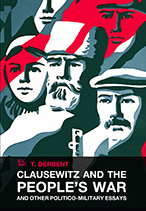 CLAUSEWITZ AND PEOPLE'S WAR
and other politico-military essays
by T. Derbent
First edition. Paris: Foreign Languages Press, 2025.
ISBN: 978-2-493844-65-1 (464pp.) PDF (free download)
Studying the relationship between war and politics—the interplay between the military command, the civil government, and the people, as well as the phenomena that lead to or hinder the escalation of violence—Clausewitz amassed a substantial and original body of work, which gained increasing recognition from the end of the 19th century. But it was not within the ranks of the military command that Clausewitz's thinking had the greatest impact. Instead, his closest readers were to be found among the theoreticians and practitioners of people's and revolutionary war. While Clausewitz's influence on Lenin has long been documented, the imprint of his ideas on Engels, Mao, Giáp, and others has remained relatively unknown. The first French edition of Clausewitz and the People's War illuminated this influence and made it possible, beyond the history of ideas, to approach questions of revolutionary warfare from unexplored angles and to creatively engage in current and historical military debates. HIGHLY RECOMMENDED.
Theodor Derbent (pseud.) is a well known Belgian communist writer. This English translation is a revised and extended version of the original 2004 edition in French. It includes additional articles and a glossary, as well as a historical chart of political and military organizations, revolutionary and people's wars from the Napoleonic era to today. See the review by Joshua Moufawad-Paul in Marx&Philosophy, Review of Books, 23 July 2025.
Achcar, Gilbert. "Engels: Theorist of War, Theorist of Revolution." International Socialism, 2002, 97.2. Engels (1887): "And, finally, the only war left for Prussia-Germany to wage will be a world war, a world war, moreover, of an extent and violence hitherto unimagined. Eight to ten million soldiers will be at each other's throats and in the process they will strip Europe barer than a swarm of locusts. The depredations of the Thirty Years' War compressed into three to four years and extended over the entire continent; famine, disease, the universal lapse into barbarism, both of the armies and the people, in the wake of acute misery; irretrievable dislocation of our artificial system of trade, industry and credit, ending in universal bankruptcy; collapse of the old states and their conventional political wisdom to the point where crowns will roll into the gutters by the dozen and no one will be around to pick them up; the absolute impossibility of foreseeing how it will all end and who will emerge as victor from the battle. Only one consequence is absolutely certain: universal exhaustion and the creation of the conditions for the ultimate victory of the working class. That is the prospect for the moment when the systematic development of mutual one-upmanship in armaments reaches its climax and finally brings forth its inevitable fruits."
Ancona, Clemente. "Der Einfluss von Clausewitz' Vom Kriege auf das marxistische Denken von Marx bis Lenin." Günther Dill, ed. Clausewitz in Perspektive. Materialien zu Carl von Clausewitz "Von Kriege," hg. v. Günter Dill. Frankfurt am Main, Berlin, Wien 1980.
Berger, Martin. Engels, Armies and Revolution: The Revolutionary Tactics of Classical Marxism. Hamden CT: Archon Books, 1977. The Internet Archive has a very partial PDF at https://archive.org/details/engelsarmiesrevo0000berg/mode/2up
JSTOR: Reviews by:
Alfred G. Meyer, International Labor and Working-Class History, No. 16 (Fall, 1979), pp. 73-75;
David Felix, The American Historical Review, Vol. 83, No. 4 (Oct., 1978), pp. 997-998.
Bi, Jianxiang, "The Impact of Clausewitz on Mao: War and Politics," MA Thesis, Department of Political Science, University of Alberta, Edmonton, Alberta, Canada, Spring 1989. 173pp.
Bi, Jianxiang. "On Strategies of East Asian Limited Wars: States, Militaries, Technologies." Doctoral dissertation, Carleton University [Canada], 1996.
Blackledge, Paul. "War and Revolution: Friedrich Engels as a Military and Political Thinker." War & Society, 2019, 38:2, 81-97, DOI: 10.1080/07292473.2019.1566981
Braun, Otto. "Vorwort." W.I. Lenin, Clausewitz' Werk »Vom Kriege«: Auszüge und Randglossen, Mit Vorwort und Anmerkungen von Otto Braun. Berlin: Verlag des Ministeriums für Nationale Verteidigung, 1957.
Carl von Clausewitz, Vom Kriege (in Russian). Карл фон Клаузевиц О ВОЙНЕ. This is the 1934 Russian translation of Vom Kriege made by A. K. Rachinsky, edited by A. A. Svechin [executed 1938] (Moscow: Gosvoyenizdat Publishing House, 1934). This version was put out by publisher Eksmo, Midgard, in 2007. A better but technically somewhat complicated version of the 1934 Russian translation can be found at Militera.Lib.Ru.
Collectif. Le marxisme et la question militaire. Paris: Le Fil du Temps no.10, EDI, 1974.
Cormier, Youri [PhD Candidate, War Studies, King's College London]. "Fighting Doctrines and Revolutionary Ethics." Journal of Military and Strategic Studies, Vol. 15, Issue 1, 2013. [Abstract: "The expression 'Clausewitz connection' has become the standard go-to term for showcasing how keen many Marxists were in citing and applying ideas from On War to their revolution. That being said, the 'connection' has often been exaggerated. Azar Gat made this case effectively by digging up the original exchanges between Marx and Engels and showing they were by no means devout Clausewitzians, even though they read and commented on at least sections of his book, Vom Kriege. The error among scholars has been to expect a connection based on methodological affinities alone. A closer scrutiny reveals that while their methodology had similarities, it was not the methodology that mattered. In fact, the way the revolutionaries cited Clausewitz was strategic, but shallow and far removed from method. Instead, what becomes clear is that the ethical dimension of Clausewitz best explains where and how the revolutionaries linked up with his system, and more importantly where they broke away. To arrive at this conclusion, one must consider the surprising fact that while the Communists were indeed citing Clausewitz, albeit not as much as has been claimed, their Anarchists co-revolutionaries in the anti-bourgeois movement were not citing him at all. Their fighting doctrines were instead tied up closely with Hegel. This exclusive relationship tells us something about how the two groups understood the ethics of political violence—as 'instrumental' in the Clausewitzian tradition, or as a 'right' in the Hegelian tradition—and how this complicated the integration of Clausewitz into communist doctrine and made him altogether irrelevant to anarchist doctrine. "]
Davis, Donald E., and Walter S.G. Kohn. "Lenin as Disciple of Clausewitz." Military Review, September 1971, 49-55. [See also Lenin, V.I. "Lenin's Notebook on Clausewitz." Ed./trans. Donald E. Davis and Walter S.G. Kohn. In David R. Jones, ed., Soviet Armed Forces Review Annual, vol.1. Gulf Breeze, FL: Academic International Press, 1977, pp.188-229.]
Derbent, T. [Thierry or Theodore, pseud.] Clausewitz et la guerre populaire, Aden, 2004, Bruxelles, 190 p. (Suivi de deux textes inédits Notes sur Clausewitz de Lénine et Conférences sur la petite guerre de Clausewitz). ISBN 2930402024.
Débat: "Clausewitz ou Mao Zedong?" [see https://lesmaterialistes.com/contre-informations/]
It appears "Les Materialistes" has subsumed the old "Contre-Informations." There are a great many additional references to material concerning Mao listed on this page.
See also: https://lesmaterialistes.com/pensee-guide-coeur-maoisme
"Clausewitz ou Mao Zedong?"
Par le Parti Communiste Marxiste-Léniniste-Maoïste (France), publié dans "Révolution" n°4 (décembre 2008), l'organe du PCMLM.
Cet article est une critique de Derbent's Clausewitz et la guerre populaire.
https://josefranciscoescribanomaenza.files.wordpress.com/2015/12/aqui.pdf
éléments de réponse au journal "Révolution"
Par T. Derbent (janvier 2009), mise en lien sur "Contre-information", le site du PCMLM.
"Le rôle de la France napoléonienne dans la genèse du nazisme (pour en finir avec Clausewitz)"
Par le PCMLM, publié dans "Révolution" n°10", (avril 2009).
Toujours en réponse au journal "Révolution"... (pour en finir avec la transformation de Clausewitz en bouc émissaire anti-révisionniste)
Par T. Derbent (juin 2009).
*** See also T. Derbent's own website. This site disappeared from the web sometime during the Covid pandemic. We have taken the liberty of reposting it to the ClausewitzStudies.org, server—with, unfortunately, many broken links (which we are working to fix). See also his Clausewitz bibliography. The original website, https://tderbent.org/, was recently restored (as of late October 2023).
Derbent, T. Giap et Clausewitz (Suivi de Contribution à l'histoire de Dien Bien Phu et de Préface au livre du général Giap: guerre du peuple, armée du peuple). Aden, 2006, Bruxelles, 125 p. ISBN 2930402253. [More info from T. Derbent]
See also:
Derbent, "Allocution de Hanoi": "Allocution prononcée lors de la conférence de travail à la Bibliothèque de l’Armée populaire, à Hanoï, sur l’influence de Clausewitz sur la pensée militaire vietnamienne, à l’initiative du général Hong Cu."
Derbent, "Clausewitz et Giap [Un complément inédit à Clausewitz et la guerre populaire] Une introduction dispensable."
Derbent, "Vo Nguyen Giap." (Also in German.)
Derbent, "Bibliographie critique de l’ouvrage."
Derbent, "Bibliographie du général Giap."
Derbent, T. Clausewitz et les structures militaires du KPD (1920-1945), chapitre complémentaire à Clausewitz et la guerre populaire ayant fait l'objet d'un tiré à part aux éditions Aden, Bruxelles, septembre 2006. Avec un schéma: Les structures militaires du KPD (1920-33 et en annexe: A. Bubnow: Lénine sur Clausewitz (publié dans la revue Oktober n°4, 1931). [More info from T. Derbent]
Derbent, T. "Clausewitz, Mao et le maoïsme." Complément à Clausewitz et la guerre populaire paru dans la revue Clarté rouge n°4, Bruxelles, mai 2013, pp. 13-29. [More info from T. Derbent] Spanish translation.
See also: English translation, Derbent, T. "Clausewitz, Mao, and Maoism," trans. Christopher Bassford, ClausewitzStudies.org, May 2020. DRAFT.
Derbent, "Clausewitz dans l'héritage maoïste." [Un complément inédit de Clausewitz et la guerre populaire.]
Derbent, T. Franz Mehring et Clausewitz. Complément à Clausewitz et la guerre populaire publié sous forme de plaquette bilingue (français-allemand) publiée à l'occasion de la Foire du Livre de Francfort 2013. Zambon Verlag, Francfort sur le Main, 2013. [More info from T. Derbent]
Derbent, T. De Foucault aux Brigades Rouges: Misère du retournement de la formule de Clausewitz [From Foucault to the Red Brigades: Misery from the reversal of Clausewitz's formula]. Aden, 2016, Bruxelles, 215 p. (Suivi du texte de Renato Curcio Contre Clausewitz et de deux chapitres de Politico e Rivoluzione des prisonniers des Brigades rouges). ISBN: 280592083X [See more info from T. Derbent]. En Anglais: "'War is nothing but the continuation of policy with other means.' Rarely has a phrase been so successful, and never has it been so tempting to turn it around. Relying on Carl Schmitt and this turnaround, a whole current in the Red Brigades embarked on a 'total social warfare' finding an echo among The Invisible Committee and The Conspiracy of Fire Nuclei. Foucault sought the roots of power in it, whereas Deleuze and Guattari sought the ultimate sign of the 'machine of war' and Negri the truth of the Empire. T. Derbent expounds here, without sparing us any details, the adventures of this turnaround, which was wrongfully attributed to Lenin, but can already be found in the work of Proudhon."
Derbent, T. "Pour une doctrine militaire prolétarienne (ou pas) : Le débat Frounzé-Trotski de 1920-21." Période. Post-1917.
Résumé de l'article: Auteur en 2004 d’une étude capitale réexaminant les guerres populaires et révolutionnaires à la lumière de la pensée de Clausewitz, Theodor Derbent se penche ici sur la dispute qui, au lendemain de la guerre russo-polonaise, a opposé Trotski aux partisans d’une « doctrine militaire unifiée », au premier rang desquels Mikhaïl Frounzé (parfois appelé le « Clausewitz soviétique ») et Nikolaï Goussev. Ces débats se fondaient sur une série d’oppositions : là où les « communistes militaires » prônaient une stratégie offensive, condition de l’exportation internationale de la révolution, et la création d’une armée permanente, Trotski quant à lui privilégiait l’ « autodéfense » du régime soviétique et, dans la lignée de Jaurès, la formation d’un système de milices. Se revendiquant de l’expérience de la guerre civile, Trotski refusait radicalement la « mise en dogme » des contingences empiriques du combat, autrement dit l’idée même d’une science militaire prolétarienne, de la même manière qu’il rejetait celle de culture prolétarienne. Prenant le parti des communistes militaires, Derbent dévoile les faiblesses de la position d’un Trotski ignorant les enjeux des guerres futures, l’évolution des techniques militaires, et faisant preuve d’un manque de perspicacité flagrant en matière stratégique. Derbent revigore ainsi l’idée d’une pensée communiste de la guerre que ne sauraient épuiser les réflexions actuelles sur la violence.
** Derbent, T. [Theodor]. Clausewitz et la guerre Populaire Et autres essais politico-militaires. Première Édition. Paris: Éditions en Langues Étrangères, Collection “Nouveaux chemins” # 17 (Français), 2024. ISBN : 978-2-493844-62-0. [local backup] Announcement. See illustration from the book below (click for larger image). PDF (Téléchargement gratuit.)

** Derbent, T. [Theodor]. Clausewitz and the People's War and other politico-military essays. First edition. Paris: Foreign Languages Press, Collection "New Roads" #17, 2025. ISBN: 978-2-493844-65-1 (464pp.) Free PDF. [local backup] Studying the relationship between war and politics—the interplay between the military command, the civil government, and the people, as well as the phenomena that lead to or hinder the escalation of violence—Clausewitz amassed a substantial and original body of work, which gained increasing recognition from the end of the 19th century. But it was not within the ranks of the military command that Clausewitz's thinking had the greatest impact. Instead, his closest readers were to be found among the theoreticians and practitioners of people's and revolutionary war. While Clausewitz's influence on Lenin has long been documented, the imprint of his ideas on Engels, Mao, Giáp, and others has remained relatively unknown. The first French edition of Clausewitz and the People's War illuminated this influence and made it possible, beyond the history of ideas, to approach questions of revolutionary warfare from unexplored angles and to creatively engage in current and historical military debates. HIGHLY RECOMMENDED.
Dexter, Byron. "Clausewitz and Soviet Strategy." Foreign Affairs, v.29, no.1 (October 1950). 41-55.
https://www.foreignaffairs.com/articles/russian-federation/1950-10-01/clausewitz-and-soviet-strategy
https://www.proquest.com/docview/1290268324?sourcetype=Scholarly%20Journals
https://www.jstor.org/stable/20030813?origin=crossref
Gallie, W. B. Philosophers of Peace and War: Kant, Clausewitz, Marx, Engels and Tolstoy. Cambridge: Cambridge University Press, 1978.
Gat, Azar. "Marxism, Clausewitz, and Military Theory 1848 to the Nuclear Age." In Gat, The Development of Military Thought: The Nineteenth Century. Oxford: The Clarendon Press, 1992, pp.226-246.
Gat, Azar. "Clausewitz and the Marxists: Yet Another Look." Journal of Contemporary History, v.27 (1992), 363-382. Preview
Gibbs, Norman. "War," "Part A: The Western Theory of War." Ed. C.D. Kernig. Marxism, Communism and Western Society: A Comparative Encyclopedia. New York: Herder and Herder, 1972-1973.
Glucksmann, André, "Politics and War in the Thoughts of Mao Tse-tung," New Left Review 1/49 (May/June 1968).
Haffner, Sebastian. "Mao und Clausewitz," in Chapter VII, "Volkskrieg," in Günter Dill, ed., Clausewitz in Perspektive: Materialien zu Carl von Clausewitz: Vom Kriege. Frankfurt/M. Berlin/Wien: Ullstein, 1980, S. 652–663. Aus: Mao Tse-tung, Theorie des Guerillakrieges oder Strategie der Drinen Welt. Einleitender Essay von S. Haffner, Reinbek 1966 (= rororo aktuell Bd. 886), S. 14-22.
Hagena, Hermann. "'Offensive' Verteidigungsstrategie im Lichte von Lenin und Clausewitz." Rissener Rundbrief, Mai 1988, 177-183.
Hahlweg, W[erner]. "Lenin und Clausewitz. Ein Beitrag zur politischen Ideen-geschichte des 20. Jahrhunderts." Archiv für Kulturgeschichte, XXXVI. Bd. (1954), Heft 1, 3.: S. 357- 87.
Hahlweg, Werner. "Clausewitz, Lenin and Communist Military Attitudes Today." Journal of the United Service Institutes, v.CV, no.618 (May 1960), 221-225.
Lehrmeister des kleinen Krieges, von Clausewitz bis Mao Tse-tung und (Che) Guevara. Darmstadt, Wehr und Wissen Verlagsgesellschaft [1968]. Description: 275pp. LC call# U240 .H23.
Hampel, Frank R. Zwischen Guerilla Und Proletarischer Selbstverteidigung: Clausewitz, Lenin, Mao Zedong, Che Guevara, Koerner. Frankfurt am Main ; New York : P. Lang, c1989. ISBN 3631416938.
Holeindre, Jean-Vincent. "Violence, guerre et politique: Étude sur le retournement de la 'Formule' de Clausewitz." Res Militaris, an online social science journal, vol.1, n°3, Summer/Été 2011. [From the Abstract: This article presents an analysis of the thought of such authors as Lenin, Ludendorff, Schmitt, Foucault, and Girard, who all reversed Clausewitz's famous "Formula" in Vom Kriege: "War is the continuation of politics by other means." • Cet article se propose d'étudier la pensée des auteurs qui, de Lénine à René Girard en passant par Ludendorff, Carl Schmitt et Michel Foucault, ont retourné la célèbre 'Formule' de Clausewitz, tirée de son traité Vom Kriege: "la guerre est la continuation de la politique par d'autres moyens."]
Holmes, James R. [co-author of Red Star over the Pacific, an Atlantic Monthly Best Foreign Affairs Book (2010); former US Navy surface warfare officer]. "Clausewitz, Sun Tzu, or Mao Zedong? Who do you consider the best military strategist?" The Diplomat, November 26, 2012.
Huntzinger, J., Introduction aux relations internationales, point, 1987, 358pp. (Discusses Clausewitz in the context of international relations theories alongside Machiavelli, Vattel, Marx, etc.).
Juvan, Jelena and Prof. Dr. Vladimir Prebilic. "Clausewitz in a Post-Communist State: A Case Study of Slovenia," pp.264-287 in Clausewitz Society [Clausewitz Gesellschaft, Hamburg], Reiner Pommerin, ed. Clausewitz Goes Global: Carl von Clausewitz in the 21st Century. (Commemorating the 50th Anniversary of the Clausewitz Society.) Berlin: Carola Hartmann Miles Verlag, 2011.
Kipp, Jacob W. "Lenin and Clausewitz: The Militarization of Marxism, 1914-1921." Military Affairs, October 1985, 184-191.
Kober, Paul M., translator. “Clausewitz and the Communist Party Line: A Pronouncement by Stalin.” Contains introduction and translation by Paul M. Kober; letter to Stalin by Professor Colonel E. Razin [Red Army], January 30, 1946; reply to Razin by J. Stalin, February 23, 1946. Military Affairs, Vol. 13, No. 2 (Summer, 1949), pp. 75-78.
Kolkowicz, Roman. "On Limited War: Soviet Approaches." Robert O'Neill and D.M. Horner, eds. New Directions in Strategic Thinking. London: George Allen and Unwin, 1981.
Kondylis, Panajotis. Theorie des Krieges: Clausewitz, Marx, Engels, Lenin. Stuttgart 1988.
Lenin, V.I. "War and Revolution" [a lecture delivered 14 (27) MAY 1917). First published according to the shorthand report April 23, 1929 in Pravda No. 93. From Lenin Collected Works. Moscow: Progress Publishers, 1964, Moscow, Volume 24, pages 398-421. "We all know the dictum of Clausewitz, one of the most famous writers on the philosophy and history of war, which says: "War is a continuation of policy by other means."[4] This dictum comes from a writer[See Clausewitz, On War, Vol. 1] who reviewed the history of wars and drew philosophic lessons from it shortly after the period of the Napoleonic wars. This writer['s...] basic views are now undoubtedly familiar to every thinking person...." Posted on-line by Marxists.org.
Lenin, W.I.: Clausewitz' Werk "Vom Kriege." Auszüge und Randglossen. Mit Vorwort und Anmerkungen von 0tto Braun: (Ost) Berlin: Verlag des Ministeriums für Nationale Verteidigung, 1957.
Lenin, V.I. "Lenin's Notebook on Clausewitz." Ed./trans. Donald E. Davis and Walter S.G. Kohn. In David R. Jones, ed., Soviet Armed Forces Review Annual, vol.1. Gulf Breeze, FL: Academic International Press, 1977, pp.188-229. The text has been posted to The Clausewitz Homepage with the kind permission of Academic International Press. This is a translation of V.I. Lenin, "Notebook of Excerpts and Remarks on Carl von Clausewitz, On War and the Conduct of War, in V.V. Adoratskii, V.M. Molotov, and M.A Savel'ev, eds., Leninskii sbornik (Lenin Miscellany), (2nd ed., Moscow-Leningrad, 1931), XII, 389-452. Includes preface by A.S. Bubnov, explanatory notes by A. Toporkov, and considerable bibliographical information.
MAO ZEDONG: On Mao's direct and intimate familiarity with Clausewitz's work, see especially T. Derbent, "Clausewitz, Mao et le maoïsme," whose assessment (writing in French and based to a large extent on Zhang Yuanlin's research in German)—was much more conclusive than his earlier thinking in Derbent, Clausewitz et la Guerre Populaire (Bruxelles: Aden, 2004).
Much of Mao's published work is on-line in English on Marxists.org. See also T. Derbent's very useful website. [The original has disappeared. This is a reposting by ClausewitzStudies.org.]
Mao Zedong. Selected Military Writings. Beijing: Foreign Languages Press, 1977.
Mao Zedong. On Protracted War, in Military Writings of Mao Tse-tung, Editions in foreign languages, Beijing, 1964, page 259. On Mao's direct and intimate familiarity with Clausewitz's work, see T. Derbent, On-line in English on Marxists.org.
Mao Zedong. "Problems of Strategy in China's Revolutionary War," in Military Writings of Mao Tse-tung, Editions in foreign languages, Beijing, 1964.
Münkler, Herfried. '”Krieg und Frieden bei Clausewitz, Engels und Carl Schmitt. Dialektik des Militarismus oder Hegung des Krieges.” In Leviathan, 10. Jg., 1982, Heft 1, S. 16-40; in leicht veränderter Form In Herfried Münkler, Gewalt und Ordnung, S. 54-79.
Office of the Director of Intelligence, USAF. "Outlines of the Principles of Warfare from Clausewitz to the Present Time." ["An unclassified study, in outline form, dealing with the development of modern theories of warfare as propounded by Clausewitz, Ludendorff, Engels and Marx, Trotsky, Lenin and Stalin.] Paper, Maxwell AFB, AL: Air University, 1949.
Razin, Professor Colonel E. [Red Army] “Clausewitz and the Communist Party Line: A Pronouncement by Stalin.” Contains introduction and translation by Paul M. Kober; letter to Stalin by Professor Colonel E. Razin [Red Army], January 30, 1946; reply to Razin by J. Stalin, February 23, 1946. Military Affairs, Vol. 13, No. 2 (Summer, 1949), pp. 75-78.
Renard, Thomas and Stéphane Taillat. "Between Clausewitz and Mao: Dynamic Evolutions of the Insurgency and Counterinsurgency in Iraq (2003-2008)." Small Wars Journal, October 14, 2008.
Rylander, R. Lynn. "Mao as a Clausewitzian Strategist." Military Review, v.61 (1981), no.8, 13-21.
Schmelzer, Paul. "Clausewitz and Mao." Master's thesis, Colorado State University, 1989. [Schmelzer also obtained a Ph.D. in 2010 from Texas Christian University for his dissertation, ""A Strong Mind: A Clausewitzian Biography of U.S. Grant."]
Schössler, Dietmar. Das Erkenntnis- und Praxisinteresse an der Methode von Friedrich Engels. (1. Werkstattgespräch). Die 'Reichweite' der Clausewitzschen Kategorien bei der Analyse des modernen bewaffneten Konflikts (2. Werkstattgespräch). In: Clausewitz- und Engels-Forschung im Blick auf eine europäische Strategie- und Militärwissenschaft für die neunziger Jahre. (Werkstattgespräche). Dresdener Studiengemeinschaft Sicherheitspolitik (DSS) e. V (Hrsg.): DSS-Arbeitspapiere, Dresden 1990, Heft 4.
Schössler, Dietmar. Clausewitz – Engels – Mahan. Grundriss einer Ideengeschichte militärischen Denkens (= Politik, Band 27). Lit, Berlin u. a. 2009, ISBN 978-3-8258-0220-2.
Stalin, J. “Clausewitz and the Communist Party Line: A Pronouncement by Stalin.” Contains introduction and translation by Paul M. Kober; letter to Stalin by Professor Colonel E. Razin [Red Army], January 30, 1946; reply to Razin by J. Stalin, February 23, 1946. Military Affairs, Vol. 13, No. 2 (Summer, 1949), pp. 75-78.
Staudenmaier, W.O. "Vietnam, Mao and Clausewitz." Parameters, v.VII, no.1 (1977), 79-89.
Vad, Erich. "Lenin über Clausewitz' Werk `Vom Kriege'" in: Europäische Wehrkunde 32 (1983), S.176-179.
Winczewski, Damian. "Engels Military Thought: A Few Critical Remarks." Research paper.
Zhang, Yuanlin. "Die chinesischen Ausgaben des Werkes `Vom Kriege' von Carl von Clausewitz," in: Österreichische Militärische Zeitschrift 28 (1990), S.229-230
.
Zhang Yuan-lin. "Mao Zedong und Carl von Clausewitz: Theorien des Krieges, Beziehung, Darstellung und Vergleich." Ph.D. Dissertation, University of Mannheim, 1995. Table of Contents (.pdf).
Zhang Yuanlin. "Mao Zedongs Bezugnahme auf Clausewitz." Archiv für Kulturgeschichte Volume 81: Issue 2, published online 1 Dec 1999. https://doi.org/10.7788/akg.1999.81.2.443